Why I would never use Meld Studio
TLDR: I wouldn’t recommend Meld Studio—10/10 HELL no! It’s a closed‑source, free‑service that secretly collects and sells your stream data to VC‑backed backers. If you value privacy, stick with open‑source OBS instead.


TLDR; Would I recommend using it?
10/10 HELL no!
Multi-platform streaming service - for free
That's the sales pitch.
Sales pitch? I thought it was free?
That was my initial thought when I first saw this service a little over a year ago.
Since then I have been following the progress of this product on and off. Why?
I didn't really know until now. I did a little digging and diving into the available information on Meld Studio and it's practices and it's collaborators.
As I write this, I have seen an upswing of interest in the Meld Studio in the surrounding communities. If you are not aware, I am an occasional "Live streamer" on platforms like Twitch, Youtube, Owncast and more. And with that, there comes communities and interactions. Either on platforms like Discord (which I discourage people from using until Discord fixes their privacy issues), Matrix, Mastodon and Peertube.
This renewed interest in Meld Studio as and alternative to OBS Studio is warranted - if we go by the sales pitch and the word of mouth from brainwashed, hired, streamer profiles and people who really don't care about privacy at all. I do not have to mention these - you can find them on the Meld Studio front page - flagrantly hailing this as the "next best thing" - while being paid to say so.
This particular content creator is "a strategic collaborator" and the face of a major marketing push titled "I switched from OBS to Meld Studio" which serves as a cornerstone for Meld's user acquisition strategy. You could try to convince me that this individual is doing this "for the greater good". But everything points to monetary reasons. Particularly since Meld Studio has built-in widgets that are specifically branded as collaborations with Harris Heller (oops, @Senpai I mean. Must remember anonymity... or; https://www.youtube.com/harrisheller).
This individual "strategic collaborator" has their own landing page on the Meld Studio website, which guarantees that the company can track user conversion directly attributed to their endorsement.

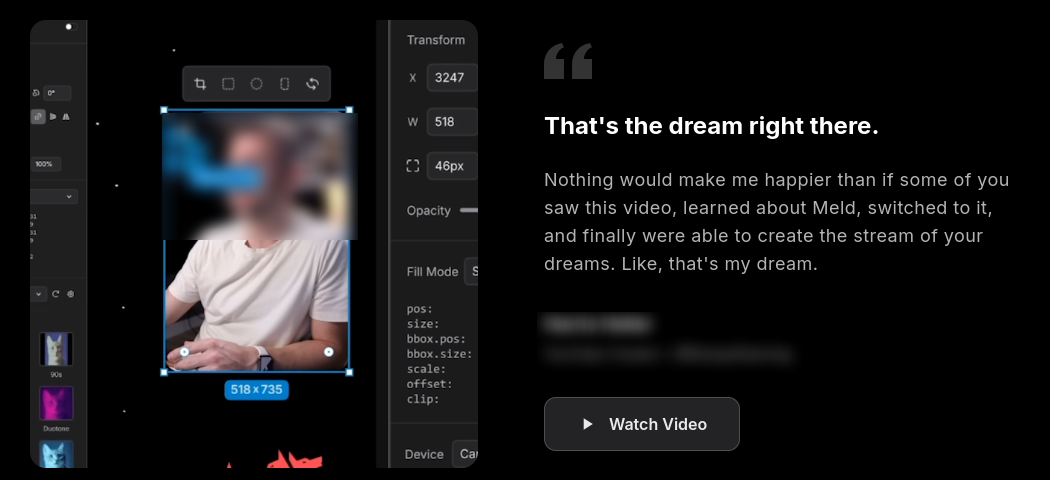
The "strategic collaborator" role is pretty well defined in the alignment of Meld's and Heller's interests intersection.
- Referral and Acquisition Value: Heller uses a custom referral link for his audience to download the software. In the venture-backed startup model, a high-profile creator driving a massive influx of "Beta" users directly increases the company's valuation for its primary backers like Yamaha and Pareto Holdings.
- Streambeats Integration: Heller’s copyright-free music empire, Streambeats, which generates significant monthly revenue (estimated at $150,000+), is frequently promoted alongside Meld Studio. By encouraging streamers to use Meld Studio - which features "Twitch VOD Track Exclusion" specifically designed to handle music like Streambeats safely - Heller creates a feedback loop that benefits his own music brand.
I can also say that, after checking some samples on the Streambeats website, they are using AI generated music in their subscription tracks. - Institutional vs. Individual Stake: Official funding records for the $2.55 million seed round highlight Yamaha Music Innovations, Notation Capital, and Pareto Holdings.There is no public filing indicating Heller is a "Founder" or "GP" (General Partner) of the company; his interest appears to be that of a strategic partner and advisor.
- Endorsement vs. Audit: Heller’s endorsement focuses on "ease of use" and "native performance". As a content creator rather than a security auditor, his public advocacy does not address the "black box" telemetry or the data collection by unnamed third-party vendors mentioned in Meld’s privacy policy.
- The "Dream" Metric: Heller has stated that his "dream" is for creators to switch to Meld.This suggests his success metric is user volume, which aligns with the goals of Meld's venture capitalist backers to scale a large user base whose data can then be commodified through Yamaha's "Music ID" platform or licensed for AI training.
On the surface, the product seems like any content creator's dream. It's got direct support for multiple platforms, combined chat, stream manager panel(s), built in widgets, tools to import your OBS Studio profiles "to get started in seconds" and much more.
Like I said - on the surface, it looks damned good.
But then we also have to do some critical thinking. These days, we really should - in ALL things "internet".
Meld Studio is a small business with only 8 registered employees.. It's backed by venture capital businesses. And the venture capitalist businesses are backed by venture capitalist companies.
What is a venture capitalist company?
A VC company is a group of investors that pools money together to look for very young, fast‑growing businesses (start‑ups) that have big ideas but need cash to get off the ground.
Now, this in and of itself is not alarming. There are hosts of VCs that empower development and make dreams come true for start-up companies (Like Meld in this case).
The main difference here is the stated streams of income for these companies.
Let's break it down.
Meld Studio's main backers:
| Investor name | Investor type | Stated streams of income | Notable Connections |
|---|---|---|---|
| Yamaha Music Innovation | Corporate Venture Capital | Sales, "experience based business models" | Yamaha Music ID |
| Notation Capital | Venture Capital | Management fees, carried interest, | AdTech, MarTech |
| Pareto Holdings | Venture Capital | Data licensing with AI services | Shutterstock, AppliedAI, Volta (Marketing) |
There are probably others, but access is restricted during my "investigation".
My main takeaway here is that all the three "big investors" are tied to data collection, advertising and marketing.
The sum is speculation, but it holds some interesting theories based on statistical data alone.
Yamaha
Yamaha's portfolio includes Rightsify, a company that provides "high integrity music datasets" to train AI models. By backing Meld Studio, Yamaha gains direct access to a pipeline of live human performance data.
This would align with Yamaha's stated interest in using AI to "elevate the artistic expression" (as part of their "Rebuild & Evolve" strategy that leverages intangible assets like intellectual property and brand design to create new AI-powered value.)
Notation
Notation Capital is a pre-seed venture fund that specializes in backing "technical founding teams" at the earliest possible stage.
My main focus on Notation is the compay's investment mandate which specifically includes Advertising Technology and Marketing Technology.
From what I can gather, the main focus for Notation (as opposed to the other investors) is to maximise the valuation of Meld Studio for an eventual exit (as an investor).
In the current market, "free" software companies are often valued on the scale and granularity of their user data.
User data that can be sold to larger aggregators or used to build proprietary AI models.
Pareto
Pareto Holdings, led by Shutterstock founder Jon Oringer, is a hybrid between a venture fund and a "venture studio" that builds companies from scratch.
My main concern with Pareto is the fact that it is led by Jon Oringer, who also founded Shutterstock. Shutterstock made it's name and fortune by "commoditising creative content".
Lately, Shutterstock has pivoted to "Data licensing with AI Services" - selling it's massive library of images, videos and metadata to tech giants for "model training" and evaluation.
Somehow I am convinced it's not about training photo models, but AI.
If Meld Studio follows the "Shutterstock playbook", the product isn't the streaming tool - it's the aggregate stream of high-definition video, audio and chat interactions produced by it's users - which can be licensed as training data for generative AI video and voice models.
From a privacy perspective, the risk is that Meld Studio is a "top of the funnel" data collector. And it's backers have the infrastructure and the historical experience and intent to turn a "free user base" into a high value, licensed data asset.
Now. That's the speculation and the obscurity.
Let's focus on the more "on the nose" issues I have seen with using Meld Studio as a streaming software. We'll make a point and counter-point argument here.
Ease of use and immutability
Meld Studio is "closed source code" which means it's easy to package, distribute, install and start using.brain
Counterpoint is that, since it IS closed source code, no one can really tell what data it transmits, what the background services are doing, and what the intent is.
Cross platform performance
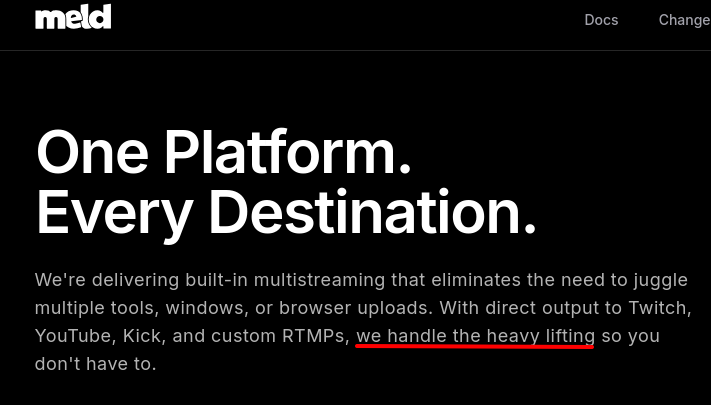
Meld Studio advertises that you can stream to multiple platforms at once - with only one upload stream. In essence this means you stream to Meld servers and they distribute the video stream to your intended platforms (like Twitch, Youtube and Kick).
Point for ease of use and lower impact on subscriber internet connection.
Counterpoint would be that in order for this to work, you have to share your authentication key(s) for your target platforms with Meld Studio back end servers. In addition (and this is where the reference to Shutterstock comes in) - you potentially allow Meld Studio to leech your data while it's passing through their cloud servers for redistribution.
Side-note: All streaming platforms say that you should never share your stream keys or authentication with any other party - be it people or machines.
Integrated Widgets
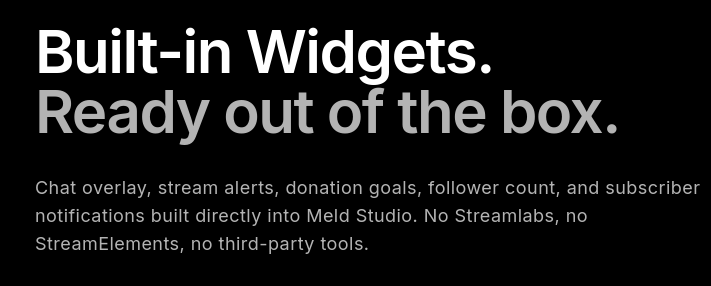
Meld Studio comes with integrated Widgets and services for all your streaming needs - just so you don't have to rely on "third party tools".
The idea is great at it's face value and possible intended core.
But please, don't be fooled by this.
What this ACTUALLY says is "Trust our Venture Capitalist backers with your (and your viewers') data" - don't use any pesky third party tools (which often are open source and transparent in what data is collected and redistributed).
The point they make is an excellent one. Ease of use, ease of mind.
Path of least resistance.
Compliance.
"Don't think about it"...
The counterpoint is already made. But essentially what they are doing here is ungracefully hoarding as much data as they can possible get their hands on.
Tell me I'm wrong! I dare you! 😈
I can back this up with a small stream of logic. So bear with me.
Meld Studio is a software product with 1 stated purpose, right?
It's for content creators to have an easier time creating content. That's it. That's the core.
Right?
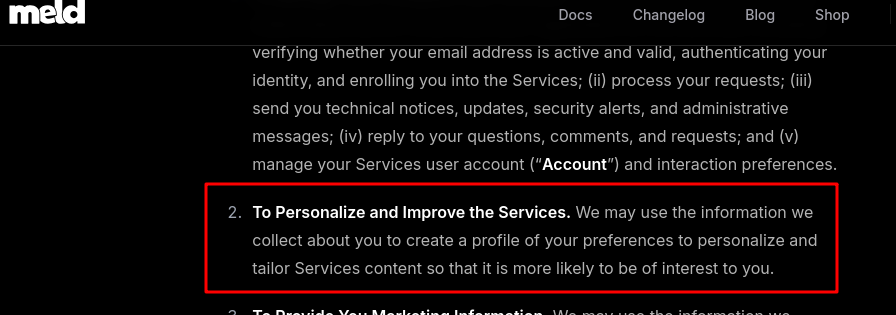
So, if the idea is benevolent and just "serving a great product" - why do they have to collect data to "create a profile of your preferences to personalize and tailor Services content so that it is more likely to be of interest to you" as it says in the Privacy Policy?
What "other services"?
The last point
I will argue this, they are lying to their users directly, overtly and with intent.
In their Privacy Policy they say:
Disclosure of Information.We do not sell the information we collect about youbut may disclose the information we collect about you in order to fulfill the purpose for which you provide it or for business and commercial purposes, including as set forth below.
Disclosure to Our Service Providers. We may share the information we collect about you as necessary with our Service Providers (as defined below), under our instructions and in compliance with appropriate contractual, technical, and organizational security measures designed to protect your data from unauthorized use, retention, or disclosure. “Service Providers” means third party service providers who perform various business services for us or on our behalf, such as data processing, cloud storage, advertising, mailing services, tax and accounting services, payment processing, regulatory support, legal services, contest fulfillment, web hosting, and analytics services. This Privacy Policy does not apply to Service Providers, and we make no representations regarding the policies or business practices of any Service Providers.
They start out by saying that they do NOT sell your data - but in the same segment also tells you that their economic partners, who monetarily supports Meld Studio, has access to your collected data "in accordance with contractual measures".
While it's not directly stated that your data will be sold - one could argue that the "service providers and contractual bonds" includes services and companies that we have shown also heavily invest in AI training datasets, Marketing and Advertising.
From what I can tell of the Privacy Policy, other than Meld stating that "we do not sell your data", there is no explicit prohibition on secondary commercial uses for your data. Including training of AI datasets and models or ad-targeting databases.
"Sale" is not defined in most U.S. statutes as "transfer of personal information for monetary consideration". Hence, Meld's "no sale" clause do not address "non-sale, non-transfer" uses that could still generate revenue for a third party.
Their point 4.4 directly allows for sharing of non-personal, aggregated or de-identified data.
Their opt out alternative only applies to future disclosures, and does not retroactively bar a provider that already obtained your data under the original contract.
Privacy Conclusion
- The policy forbids a sale of personal data.
- It does not, on its face, forbid a service provider from using that data internally (e.g., to train an AI model) as long as the use stays “within the instructions” and the contractual clauses permit it.
Bottom‑line take‑away
Meld Studio is a slick, “one‑stop” streaming platform that, on the surface, promises an easier way to reach multiple audiences. Beneath that veneer lies a closed‑source architecture, a data‑first model, and a back‑office staffed by VC‑funded players whose core expertise is advertising, marketing, and AI‑training data. The company’s privacy statement stops short of forbidding the internal use of your data by these partners—only a “no‑sale” clause. That’s a loophole many commercial data‑users love to exploit, and it’s exactly what we’re seeing on the back end: streams, chats, and metrics funneled into a pipeline that can be turned into high‑value training material for the next wave of generative models.
In short, if you value absolute control over your stream and the privacy of your viewers, Meld Studio is a risky proposition. The “free” aspect is, in reality, a data‑as‑a‑service offering that may quietly monetize your content.
A final note
The streaming landscape is still young and full of promise, but it’s also full of opportunities for data harvesters. Keep your eyes open, read the fine print, and remember that “free” often means “your data is the price.” If you’re skeptical about Meld Studio’s data model, it’s safer to stick with tools that give you the same functionality without the hidden hand‑shake behind the curtain.
Go with OBS or StreamLabls OBS
Both are community maintained, though StreamLabs do monetize some of their additions to the core software, and that alone will tell you which one I will be using...